
Agile vs. Waterfall: Selecting Your Path to Project Success
In project management and software development, the road you travel to achieve your destination is as important as the destination itself. Over the years, two reigning methodologies have taken center stage: Agile and Waterfall. But which one will suit your business, your team, and your project best? This is not a technical decision; it's a strategic one that can decide whether your project ships successfully or struggles to the line. In this guide, we'll dissect these two methods to help you make this important decision.
1. The Core Philosophy: Flexibility vs. Forethought
Deep down, Agile and Waterfall stem from two divergent philosophies.
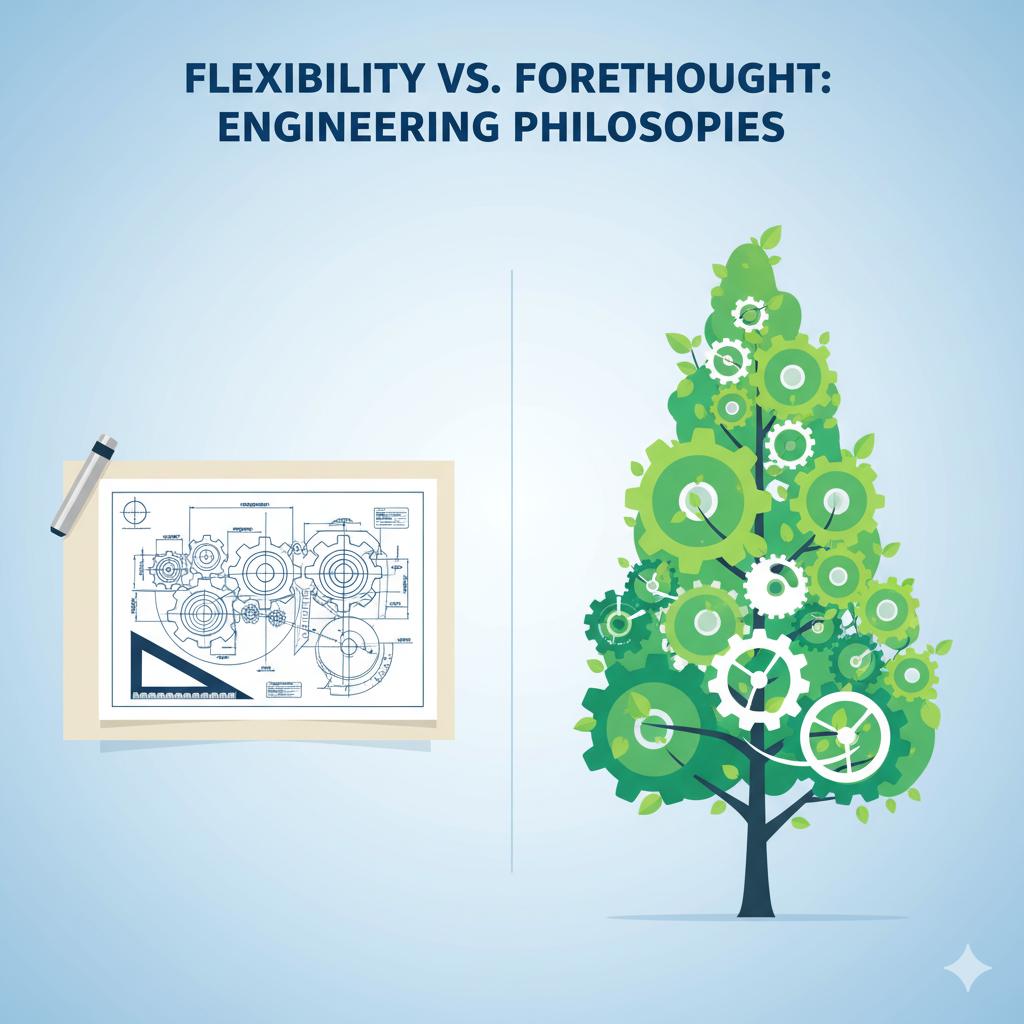
Waterfall has its roots in the philosophy of anticipation and predictability. It is based on the notion that, if there is enough planning and analysis, the needs of a project can be precisely known upfront. The whole project is planned out in a linear, step-by-step sequence, similar to constructing a house—you require the blueprints first before you ever pour the slab. Change is not considered a costly interruption to be minimized.
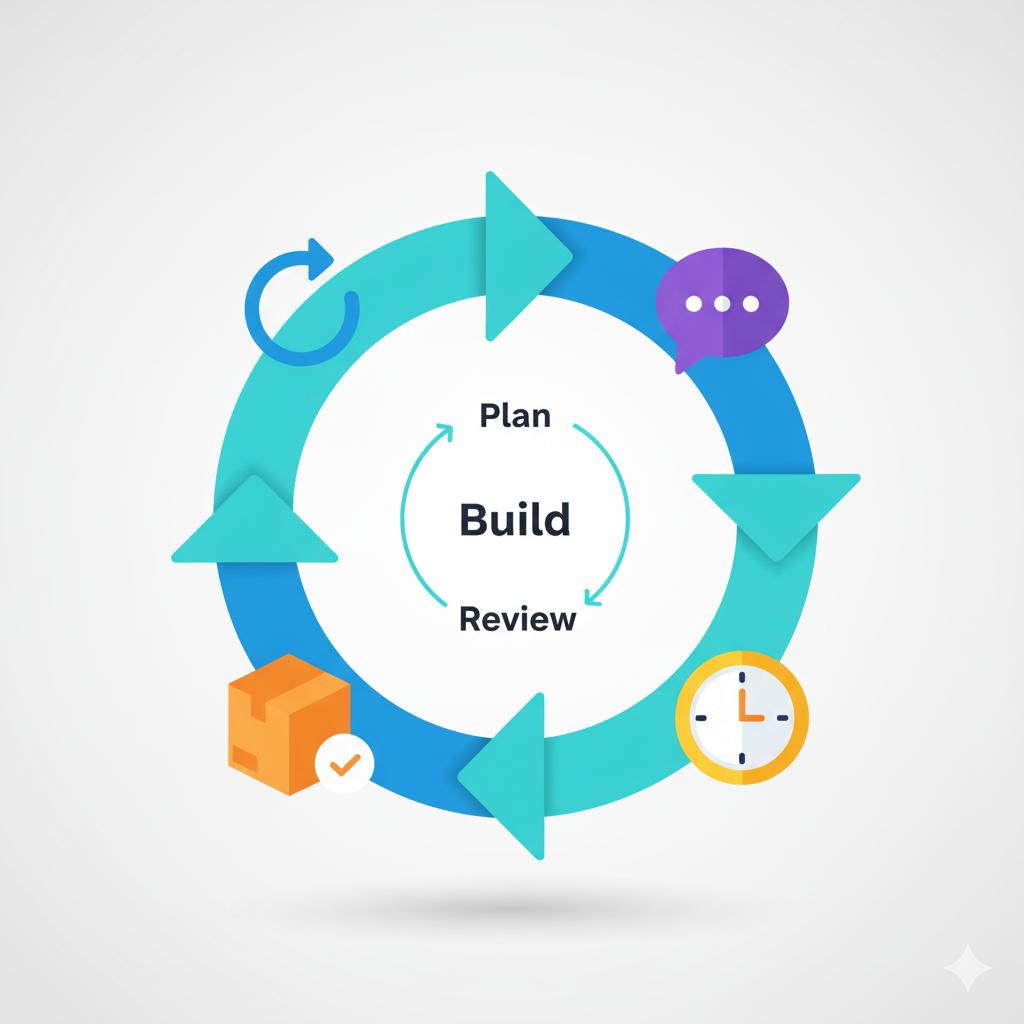
Agile, on the other hand, is constructed on the principles of flexibility and responsiveness. It accepts the fact that requirements can change, and customer needs may vary. Rather than one linear stroll, Agile divides the project into short, repetitive cycles (known as "sprints"). The team assesses the work after each cycle and adjusts the plan for the next cycle. It's less about constructing a house and more about creating a new product—you begin with a bare minimum viable iteration and iterate based on actual user feedback.
2. Dismantling the Waterfall Model: A Linear Path
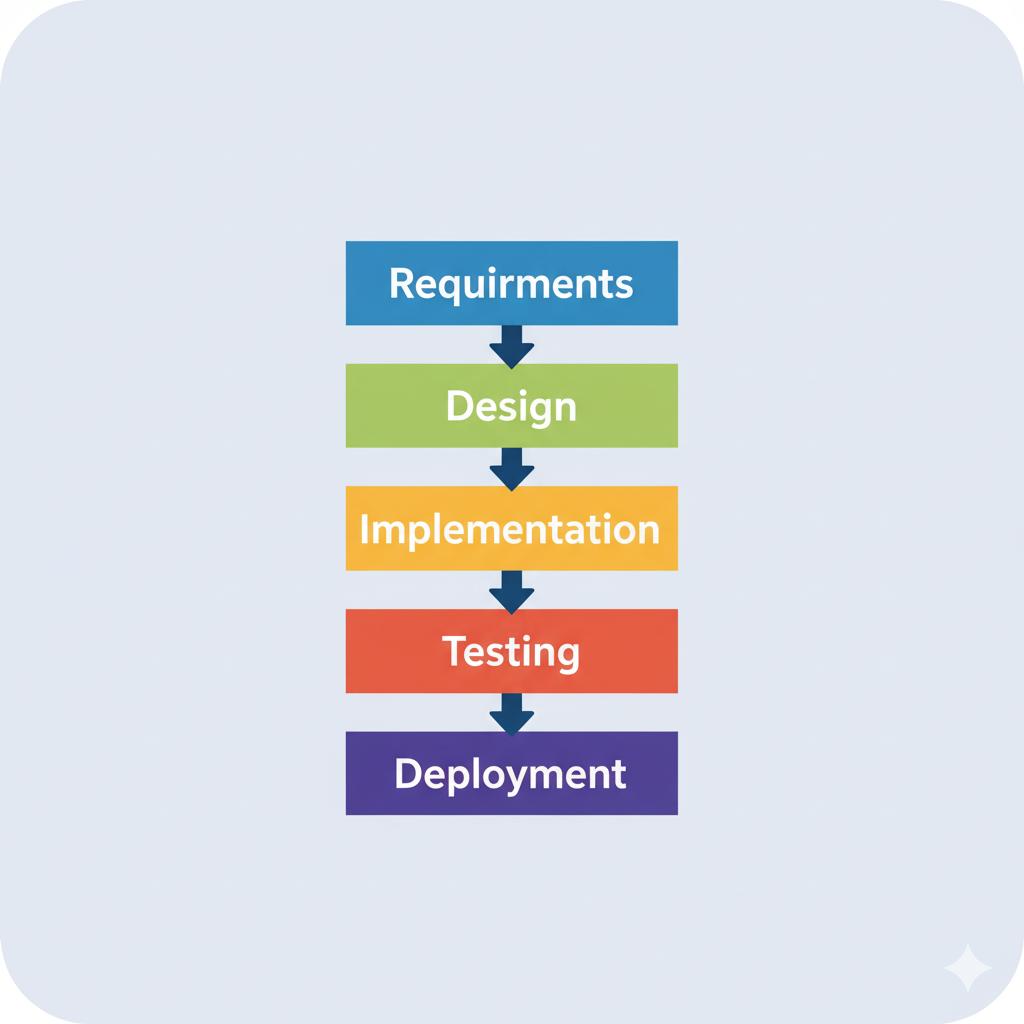
The Waterfall approach is a linear, phase-by-phase method in which each phase is completed in its entirety before the next one can proceed. Its strictness is depicted graphically as a cascade (hence the term "Waterfall") moving steadily downwards through these separate phases:
Requirements Gathering & Analysis: This is the most important phase. All requirements, features, and specifications are written down in minute detail. This becomes the bible of the project.
System Design: The technical blueprint is designed by architects and developers according to the requirements. System architecture, database design, and hardware specifications are all included.
Implementation (Development): The development team develops the code and the product based on the design documents prepared in the previous step.
Testing: After development is finished, the QA team tests the whole system against the original requirements to detect bugs or deviations.
Deployment: Once the product has gone through testing, it is rolled out to the production environment for users.
Maintenance: The product is live, and the team resolves any bugs that pop up after launch, updates, or patches.
The beauty of Waterfall is its simplicity and form. There's no confusion regarding what happens next, and the scope, cost, and timeline of the project are established right from the start.
3. The Agile Manifesto: A Mindset of Iteration
Agile is not just a process; it's a mindset captured by the Agile Manifesto, an official declaration of four primary values and twelve principles. The four values are:
Individuals and interactions rather than processes and tools.
Working software rather than extensive documentation.
Customer collaboration rather than contract negotiation.
Responding to change rather than following a plan.
This doesn't imply that the things on the right are useless; it implies the things on the left are more important.
Practically, Agile is realized through methodologies such as Scrum and Kanban. Work is divided into a "Product Backlog" (prioritized feature list). The team thereafter develops in short, time-boxed periods (typically 1-4 weeks) known as Sprints. After each sprint, the team delivers a potentially releasable "increment" of the product. Ceremonies such as the daily stand-up meeting, sprint planning, and sprint review maintain the team's focus and alignment on continuous delivery and improvement.
4. The Project Lifecycle: A Side-by-Side Comparison
Let's try to picture how a project progresses through each model.
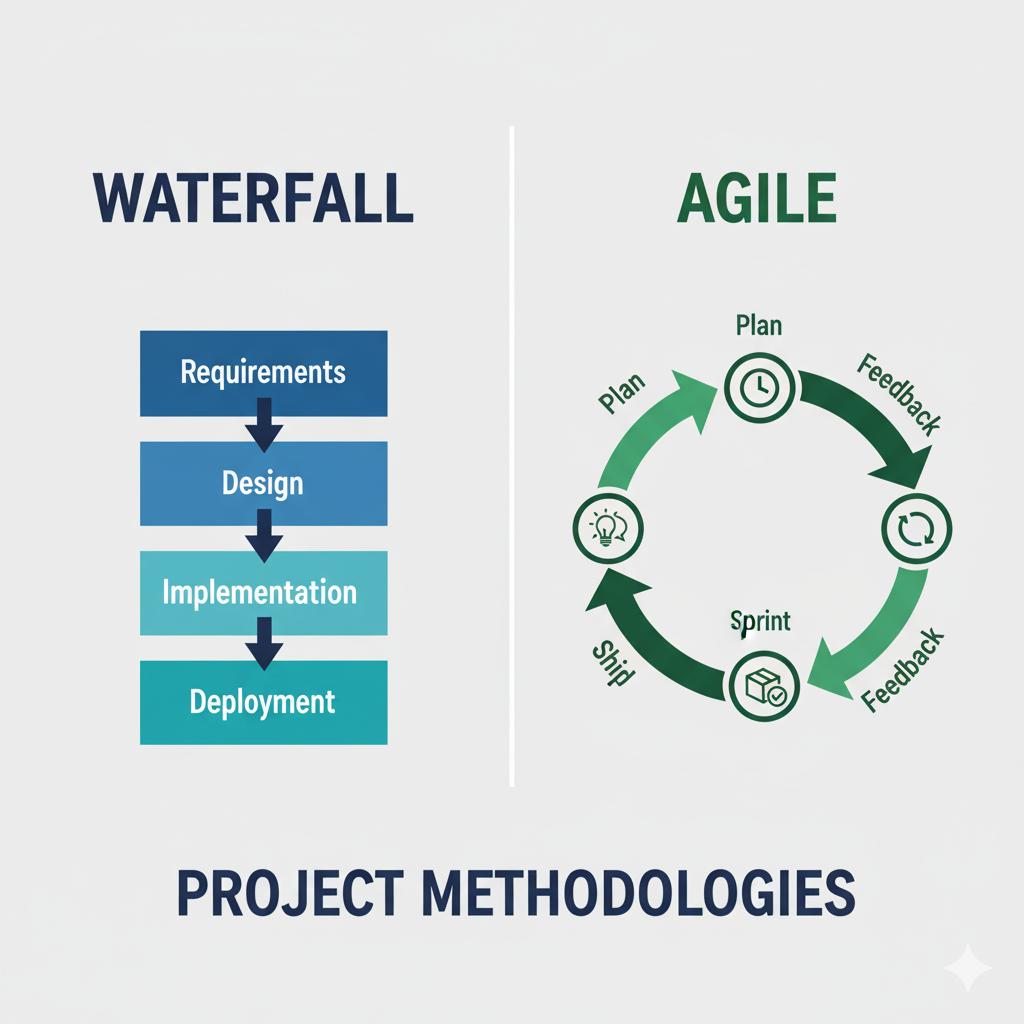
Waterfall Lifecycle:
Requirements -> Design -> Implementation -> Testing -> Deployment -> Maintenance
(A straight, one-way arrow. You can't turn around and go back to "Design" if you're already in "Implementation" without starting again or creating major disruption.)
Agile Lifecycle:
Plan Sprint -> Develop/Test in Sprint -> Review Increment -> Gather Feedback -> Adapt Backlog -> (Repeat)
(A never-ending, looped cycle. Feedback from one sprint has direct impact on next's plan.)
The most important distinction is directionality. Waterfall is a single-way road with planned exits. Agile is a spiral or a sequence of loops, always looping closer to the ideal product.
5. When to Jump into Waterfall: The Case for Predictability
Although Agile is trendy, Waterfall is certainly not outdated. It's actually the better option in certain situations where predictability and strict control matter:
Fixed Scope and Contract Projects: When there is a legally enforceable contract with a fixed price and a fixed, carefully defined scope for a project, Waterfall offers the structure required to deliver what was contracted for.
Strict Compliance with Regulations: In sectors such as aerospace, medical devices, or building construction, where heavy documentation and strict approval procedures are mandated by law, Waterfall's phase-gate model is usually called for.
Physically Constrained Projects: You just can't apply an Agile method to constructing a bridge. The physical nature of the activity calls for a sequential approach.
Simple, Easy-to-Understand Projects: On projects where requirements will not change easily and technology is stable, Waterfall's simplicity can be superior to Agile's overhead of frequent re-planning.
6. When to Adopt Agile: Succeeding in Change and Uncertainty
Agile excels in contexts where the destination is known, but not the path to it. It is the methodology of choice for:
Software Development and Digital Products: This is where Agile does its best work. Rapid iteration and the need to incorporate user feedback and respond to new technologies make it an ideal match.
Projects with Fuzzy or Changing Requirements: If you're building a brand-new, groundbreaking product and can't quite be sure what the market is looking for, Agile enables you to learn requirements along the way.
Fast-Moving Markets: In markets where customer tastes and competitive situations change rapidly, Agile offers the agility and adaptability to turn and maintain a competitive edge.
A User-Friendly Experience (UX): With the final goal being user satisfaction, Agile's continuous feedback cycles are priceless for testing and tuning the user experience.
7. Weighing the Pros and Cons: A Balanced Look
No method is infallible. The best option is determined by your individual project's constraints and requirements. Here's an easy-to-see comparison of the benefits and drawbacks of each.
Waterfall Pros:
Clarity and Structure: The explicit, linear phases make the project straightforward to comprehend and control, particularly for inexperienced complex project teams.
Predictable Budget and Timeline: With a set scope determined in advance, it is easier to estimate costs and allocate a clear-cut deadline.
Comprehensive Documentation: The strong focus on early-stage documentation guarantees requirements are obvious, an absolute necessity for maintenance and handovers.
Client Sees Final Product Early: In theory, the client sees the complete design and plan before build begins, with clear expectations.
Waterfall Cons:
Inflexible to Change: Altering things after a phase is done is famously hard, costly, and interruptive.
Late Testing & High Risk: The testing occurs only after completion of development. This implies that critical bugs or design problems can be found very late, when they are most expensive to change.
Client Feedback is Delayed: The client does not get to see a working product until the end, which results in a final product that does not address their existing needs.
"Big Bang" Release: The whole product is released simultaneously, which is overwhelming for customers and does not permit early value realization.
Agile Advantages:
Flexibility to Change: Agile's greatest strength lies in its flexibility to accept changing requirements, even towards the end of the development cycle.
Early and Reliable Delivery: Through each sprint, a new increment of the product is released, offering value to the business early and regularly.
Continuous Improvement & Feedback: Constant feedback from the end-users and client guarantees the final product closely matches their desires and requirements.
Reduced Risk of Failure: Problems are detected and solved early in every sprint, so small issues do not turn into project-destroying crises.
Agile Cons:
Less Predictable: The ultimate scope, price, and timeline might be challenging to determine initially, since the project changes.
Requires High Client Involvement: The client needs to be fully involved in the project, which can be time-consuming and costly for them.
Can Feel Chaotic: If it is not led by a well-structured Product Owner and seasoned Scrum Master, the process can easily descend into disconnected initiatives without much of a vision over the long term.
Documentation Can Be Lighter: The emphasis on delivering working software sometimes creates an inadequate amount of documentation, which will later on complicate future maintenance or new hiring.
8. The Impact on Your Team: Structure vs. Autonomy
The approach you take deeply determines your team's day-to-day experience, structure, and morale.
In a Waterfall Team: The organization tends to be hierarchical and based on roles. Specialists—business analysts, architects, developers, testers—are the team members who work alone in their own phase. Communication usually happens through formal mechanisms and much documentation. It can give individual responsibility a definite feel but can encourage silos and individual ownership. A developer could just be asked to code against a spec without seeing the larger business picture.
In an Agile Team: The organization is cross-functional and collaborative. The team is a self-forming unit of all the expertise needed to produce a slice of working software (e.g., UX designers, testers, developers work together side-by-side). The daily stand-ups encourage ongoing communication and collaborative problem-solving. It creates high autonomy, skill-sharing, and a deep sense of collective responsibility for the success of the product. But it demands proactive, communicative, and comfortable-with-ambiguity team members.
9. The Client's Role: Distant Stakeholder or Collaborative Partner?
This is among the most important differences between the two models.
In Waterfall, the Client is a Stakeholder. They are involved primarily at the very start (to specify requirements) and at the very end (to accept delivery). They are shown documents and plans for sign-off. The relationship tends to be transactional, regulated by a contract. This may seem less taxing for the client but has the potential to provide a technically correct product but one that fails the user.
In Agile, the Client is a Collaborative Partner. The role is usually taken by a Product Owner—a primary member who embodies the interests of the client and the end-users. The Product Owner is a core member of the team, actively prioritizing the backlog, stating requirements for each sprint, and giving direct feedback for every iteration. This collaboration guarantees the product develops in the correct direction, but it requires a long and persistent commitment of time from the client side.
10. Hybrid Models: Blending the Best of Both Worlds?
Realizing that unadulterated Agile or unadulterated Waterfall is not always feasible, most organizations have settled on a Hybrid model, colloquially referred to as "Wagile."
A Hybrid approach would normally employ Waterfall for high-level planning and budgeting, establishing the overall project vision and goals. It would follow this with Agile (Scrum or Kanban) for the development stage, giving flexibility and iteration within those larger boundaries.
When it works:
For big projects that need an initial fixed budget and timeline but have elements that can be iteratively developed.
In organizations that are making a switch from Waterfall to Agile, as a bridge to cultural transition.
When there are external stakeholders (e.g., finance, regulators) that demand a fixed-price contract, but the development team requires agility to manage complexity.
The Pitfalls:
The hybrid process can be the "worst of both worlds" if not handled well. It can introduce tension between the structured, high-level plan and the agile, iterative development process. Success hinges on good communication of what's fixed (e.g., budget, ultimate deadline) and what's flexible (e.g., particular features within a release).
11. Your Final Verdict: Key Questions to Determine the Best Fit
So, how do you decide? There isn't a simple answer. The most suitable approach is the one which best suits the distinct nature of your project. Ask yourself and your stakeholders these fundamental questions:
How Clear and Stable are the Requirements?
Fixed and well-defined at the beginning? → Waterfall.
Likely to change or initially unclear? → Agile.
What is the Nature of the Project?
Physical product, building, or highly regulated? → Waterfall.
Software, digital product, or innovative service? → Agile.
How Much Does Flexibility and Speed to Market Matter?
Having a flawless, fully featured product on a predetermined date matters. → Waterfall.
Having a functional product in the market quickly and iteratively enhancing it matters. → Agile.
What is Your Client's/Stakeholder's Availability?
Kick-off and final review only? → Waterfall.
Available for regular collaboration and weekly input? → Agile.
What is Your Team's Experience and Culture?
Comfortable with structured roles and procedures? → Waterfall.
Self-driven, team-oriented, and flexible? → Agile.
By answering these questions truthfully, the way ahead will be a lot clearer. Don't forget, it isn't about choosing the "best" approach in abstract, but finding the best tool for your particular task. Make your choice carefully, and set your project on its journey to success.

 Indian Online Marketing Team
Aug 10, 2025
 Indian Online Marketing Team
Aug 24, 2023
 Indian Online Marketing Team
Aug 24, 2023
 Indian Online Marketing Team
Aug 24, 2023
 Indian Online Marketing Team
Aug 24, 2023