
Choice Overload: Why Fewer Options Can Boost Your Conversions
In business, in marketing, in life, we tend to work according to a basic, seemingly inviolable assumption: more is best. More features, more products, more options—obviously, this is the way to please every possible customer and drive maximum sales.
But suppose that this fundamental belief isn't just mistaken, but actually hurting your business?
A mounting library of psychological studies and hard evidence tells us a counterintuitive fact: Overwhelming your customers with options is among the most prevalent and expensive errors you can commit. The secret to increased conversions isn't growth; it's curation.
Let's begin with the initial five explanations why adopting "less" is your strongest move towards "more."
1. Choice Overload: The Psychological Trap That's Killing Your Conversions
Choice Overload is not a buzzword, though - it's actually a well-documented psychological bias. Psychologist Barry Schwartz coined it in his book The Paradox of Choice to refer to the adverse psychological and emotional condition that humans feel when confronted with an excess of choices.
Consider the last time you attempted to select a movie from a streaming platform with hundreds of options. How many times did you scroll? Did you end up giving up and watching The Office again? That's choice overload at work.
How it Kills Your Conversions:
Decision Paralysis: When there are too many choices, the brain cannot cope with all the information and weigh the alternatives. Rather than making a strong decision, the customer is paralyzed and can't choose at all. The outcome? An empty cart and a lost sale.
Greater Anxiety & Discontentment: More options create a fear of an incorrect decision. Buyers are worried about buyer's remorse. "What if the other blender is superior? What if it's put on sale tomorrow?" This fear makes the buying experience a drag, not a thrill.
Lower Satisfaction with the Final Decision: Even post-purchase, the uncertainty remains. A customer who selected a single product from a pool of 50 will be less satisfied than a customer who selected the same product from a pool of 5. Why? Because they are strongly aware of the dozens of options not selected by them, causing post-purchase regret.
The Bottom Line: By showing your customers too many choices, you're not giving them power; you're overwhelming them. You turn a straightforward purchase into a daunting research assignment.
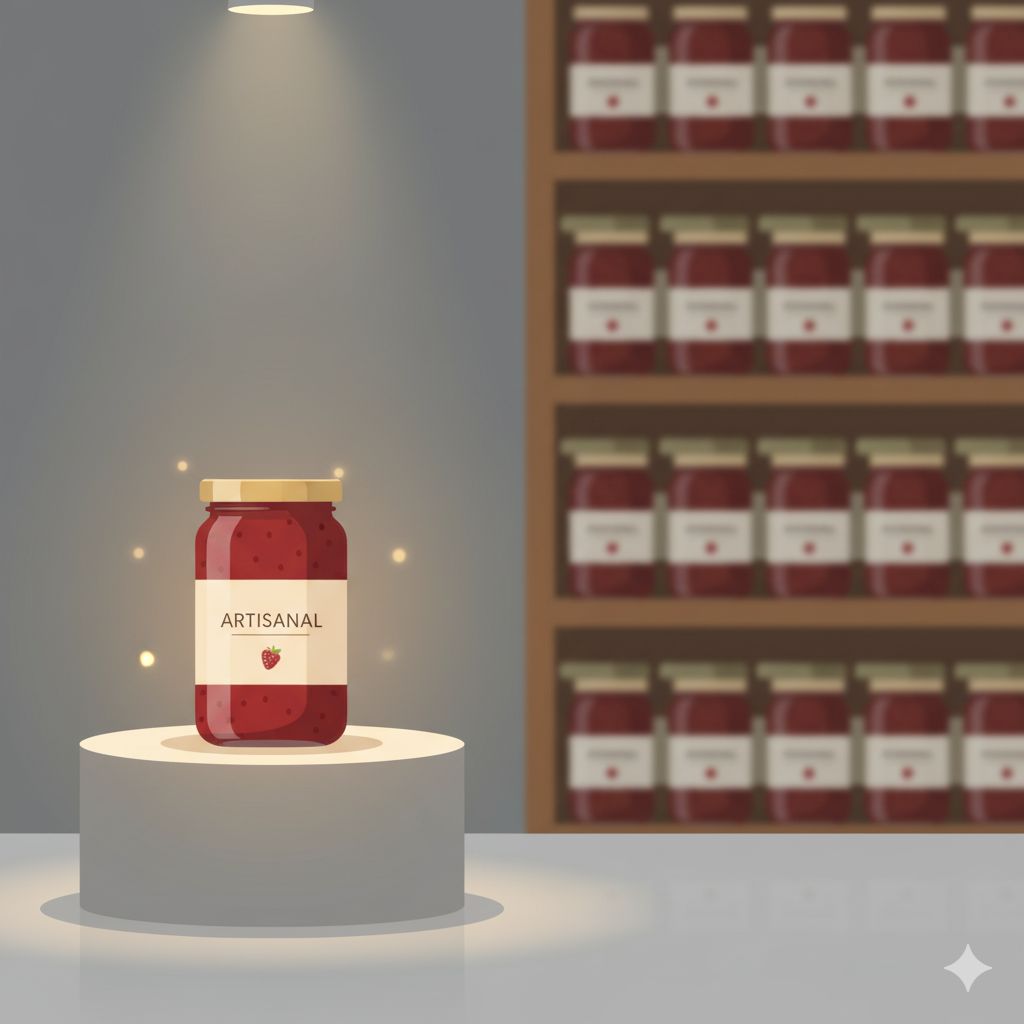
2. Less is More: The Counterintuitive Secret to Higher Conversion Rates
This rule goes against conventional wisdom, but the data speaks volumes. Reducing options doesn't reduce sales—concentrates them.
The Famous Jam Study:
The time-honored example is a study by Sheena Iyengar and Mark Lepper. In a gourmet food store, they had two taste-test booths. One had 24 flavors of jam; the other had 6.
More initial attention was drawn to the booth with 24 jams (60% of customers visited it).
But the booth with just 6 jams had a lot more sales.
A whopping 30% of consumers who were exposed to the limited range purchased something, versus just 3% of consumers who were shown the extensive display.
The "less is more" effect was evident. The smaller set was workable. Consumers could easily compare a handful of options, select one they liked, and feel good about their choice. The greater set was a spectacle, not a sales aid.
Bringing "Less is More" to Your Business:
Product Category Pages: Rather than display 100 products on a single page, apply clever filtering and display merely the top 20-30 bestsellers or most pertinent items.
Pricing Plans: Avoid presenting 7 different levels. Provide 3: Good, Better, Best. This makes the choice easy and the value proposition of each plan absolutely clear.
Homepage Design: Showcase a handpicked selection or "Staff Picks" rather than your whole stock. Lead your customers to a decision, not dump them in the deep end.
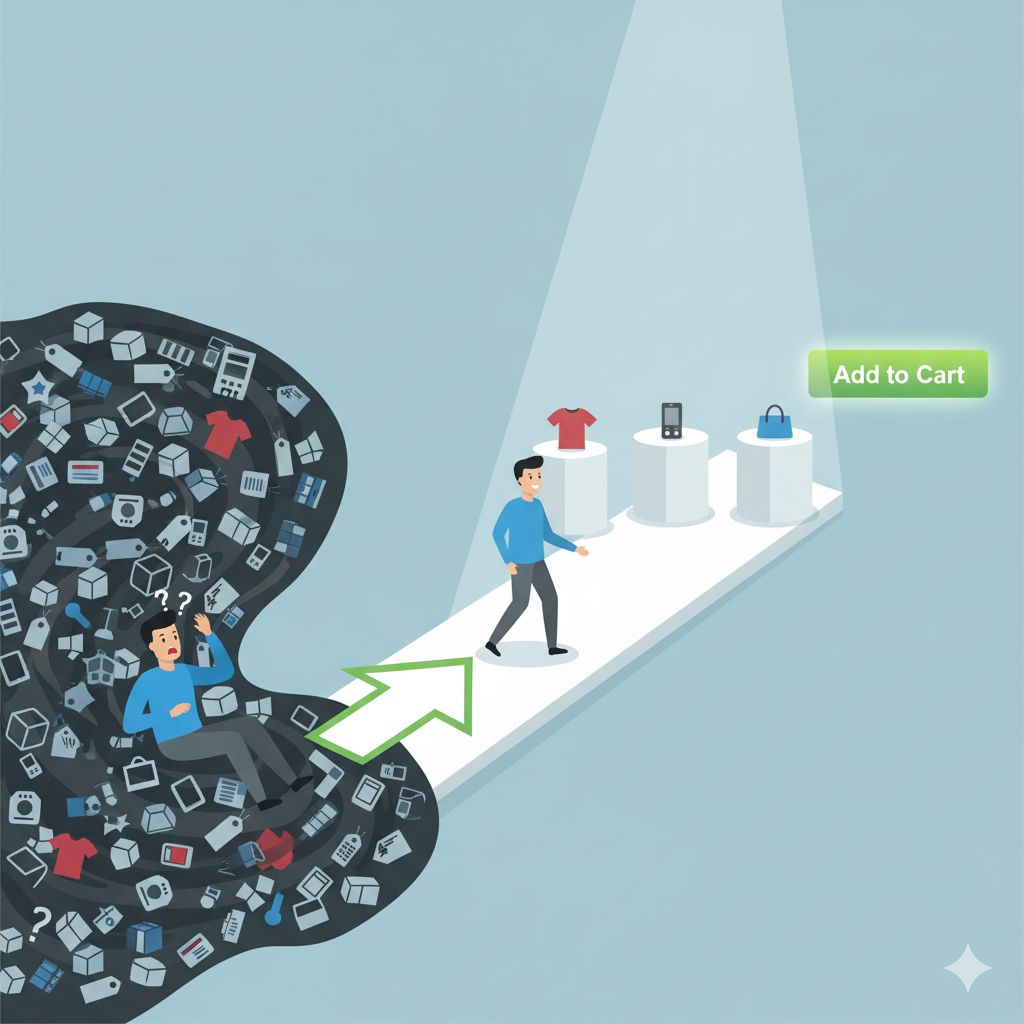
3. Why Overwhelming Your Customers with Choice is an Expensive Blunder
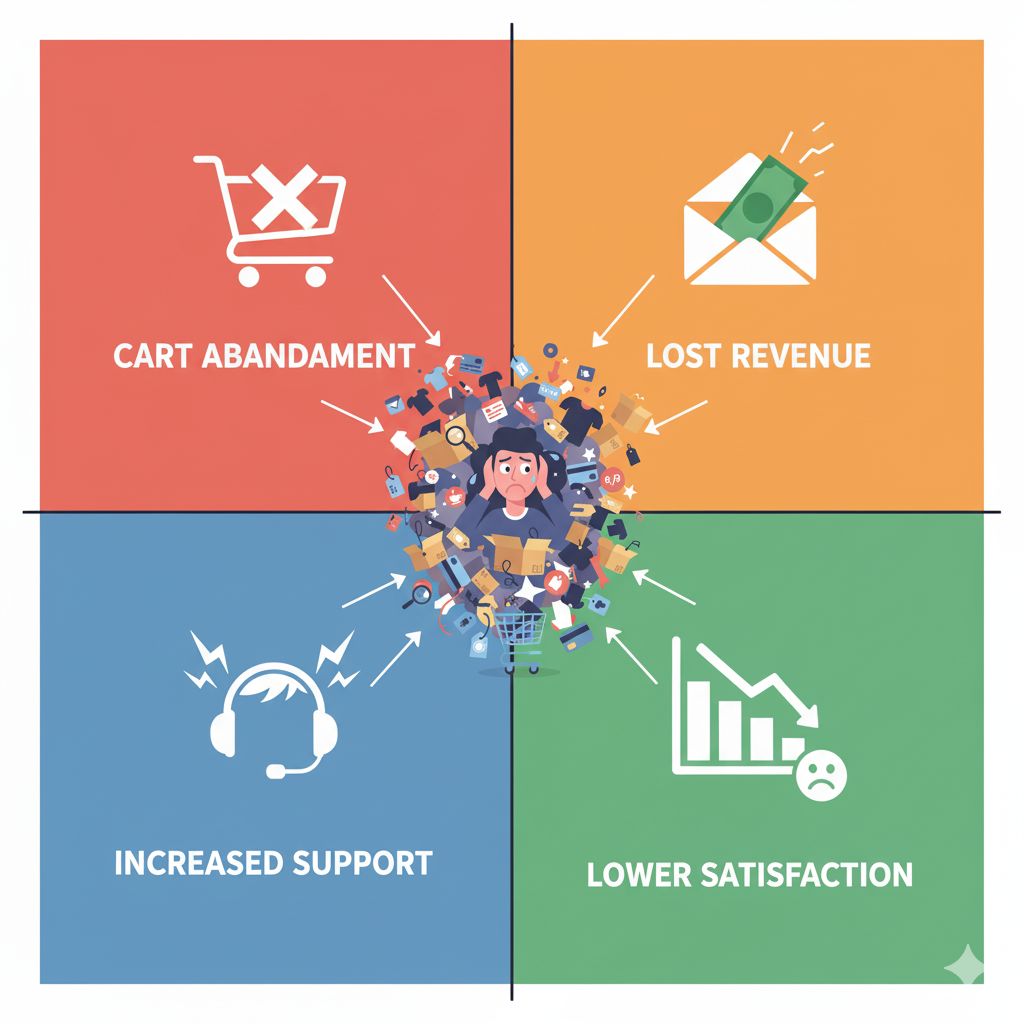
The price of choice overload isn't abstract; it lands directly in your bottom line. When you overwhelm customers, you pay for it in a number of concrete ways.
The Costs Add Up:
Sky-High Cart Abandonment Rates: Decision paralysis is a main cause of cart abandonment. A consumer who can't decide which of the 50 almost-identical t-shirts to purchase will just close the tab. That is an immediate loss of sales.
Increased Support Burden: Lost customers email support. They ask, "What is the difference between Model A, B, C, and D?" This takes your team's time and resources, driving up your operational expense.
Lower Average Order Value (AOV): A busy customer won't bother with add-ons or ancillary products. Their cognitive resources are directed at the main decision and have no bandwidth to think about a case, warranty, or accessory.
Harmed Brand Perception: A cluttered, confusing shopping experience makes your brand appear disorganized and incoherent. By comparison, a curated, streamlined experience brands you as an expert and a trusted curator.
4. From Paralysis to Action: How Making Decisions Easier Drives Sales
Your business aim is to guide customers smoothly from looking to buying. Simplifying their decisions is the best way to oil this process.
Strategies to Induce Action
Use a "Bestseller" or "Most Popular" Badge: This is an incredibly potent social proof signal, one that breaks through the noise. It says to the customer, "If you're not sure where to start, begin here. Many people have done this and are satisfied." This lowers their perceived risk.
Utilize Smart Product Comparisons: If you have to provide several similar products, give a concise comparison table with the key differences clearly outlined (e.g., "Best for Budget," "Best for Performance"). You are performing the hard labor of comparison for them.
Curate Collections: Organize products around thematic collections such as "Starter Kits," "The Home Office Essentials," or "Gift Guides for Him." This shifts the choice from "Which one of these 100 things do I want?" to "Does this pre-selected group of 5 things fix my problem?"
Provide a Recommendation Quiz: A brief, interactive questionnaire that queries the customer's needs and desires, and then offers the ideal 1-3 products, is an extremely powerful method for making the experience feel tailored and avoiding overload.
5. The Art of the Curated Choice: A Strategic Guide to Boosting Conversions
Curating options is not a lack of freedom; it's a better, more directed experience. It's the difference between leaving a tourist stranded in the middle of a gigantic city with no map compared to taking them on a tailored tour of the best 10 points of interest.
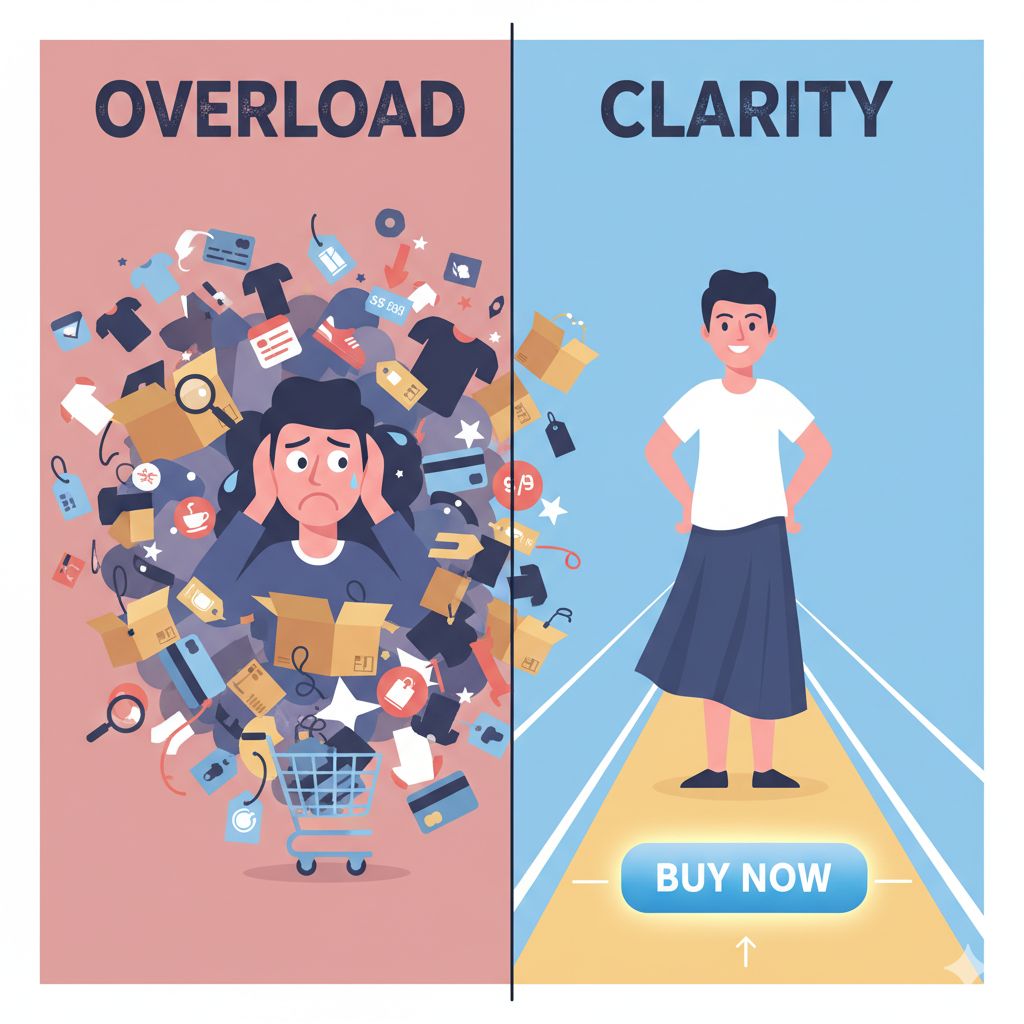
6. Break Up Endless Options: How Decision Fatigue Undermines Your Bottom Line
Decision Fatigue is the silent driver of Choice Overload. It's the psychological effect where the quality of an individual's decision-making decreases following an exhaustive session of making decisions. Consider your cognitive energy as a limited battery. Each and every decision—be it minor or significant—drains the battery.
Your customer has made dozens of micro-decisions on this day:
What to wear? What to eat for breakfast? Which email to respond to first? Which road to drive in to work? By the time they arrive on your site, their decision-making battery is half dead.
How This Ruins Your Business:
The Path of Least Resistance: When faced with yet another complex decision on your site (e.g., choosing from 50 nearly identical products), a mentally drained customer will default to the easiest option: doing nothing. Abandoning the cart requires no further mental effort.
Impulse Control Breaks Down: Decision fatigue correlates with diminished self-control. That's why you'll make more impulse purchases on junk food at the supermarket when you're exhausted. On your website, this could translate to the customer being less inclined to add a revenue-generating accessory or upgrade since it entails one additional draining decision.
Hasty, Unreasonable Decisions: Alternatively, an exhausted customer may make a hasty, less-than-optimal decision simply to finish the mental effort. This usually results in increased return rates, as they soon come to realize the product does not actually satisfy their requirements.
The Antidote: Make your customer's journey mentally economical. Make each step as easy as possible. Employ defaults, eliminate pointless clicks, and offer simple, binary decisions (e.g., "Standard vs. Pro") rather than thorny multi-variable ones.
7. The Simplification Advantage: Turning Browsers into Buyers with Fewer Options
This is where the rubber meets the road. Simplification isn't a philosophy; it's a tangible competitive edge that has a direct impact on your revenue. A simplified experience fosters trust, eliminates friction, and instills a sense of confidence that directly translates into sales.
Tactical Ways to Leverage the Simplification Advantage:
Transform Your Product Pages: Don't simply list 15 bullet-point features. Answer one question: "What problem does this solve for the customer?"
Employ Benefit-Driven Headlines: Instead of "Wireless Bluetooth Speaker," use "The Shower Singer's Dream: Waterproof, Crystal-Clear Sound Anywhere."
Emphasize Visual Simplification: Utilize high-quality visuals and videos that demonstrate the product in action. A 30-second video is likely to impart value quicker than 1,000 words of copy.
Use a "Scarcity" or "Urgency" Badge (Ethically): A more effective simplification technique than "24 left in stock" is a "Bestseller" or "Editor's Choice" badge. It says to the user, "This is a safe, popular choice."
Simplify Your Checkout Process: This is the holy grail of simplification.
Provide Guest Checkout: Forcing account creation is a high-friction moment. Make it voluntary.
Auto-Fill Data: Employ field-pre-filling tools such as city and state fields from a zip code.
Eliminate Form Fields: Review each and every field. Do you absolutely need their company name or title? For each field that is cut, a point of friction is eliminated.
8. Choice Overload Explained: The Science Behind Why Less Choice Converts More
To really nail this idea, it is helpful to know the neuroscience behind it. Our brains possess two main systems for thinking, commonly referred to as System 1 and System 2 (Daniel Kahneman's Thinking, Fast and Slow).
System 1: Automatic, fast, intuitive, and emotional. It works with minimal effort. (e.g., catching a ball, reading a plain word).
System 2: Slow, careful, analytical, and logical. It demands conscious mental effort. (e.g., working out a tricky math problem, comparing the specifications of 20 various laptops).
The Science of Overload:
Offering a customer an enormous number of options involuntarily activates System 2. You are requiring them to do a time-consuming, effortful analysis. This is cognitively exhausting and unsavory.
Offering a customer a handpicked selection of 3-4 options, though, enables System 1 to work smoothly. They might be able to make a visceral, intuitive decision based on a distinct differentiator (price, color, easy-to-understand feature). This is easy and pleasant.
The "Cognitive Load" Principle
Cognitive load theory tells us that working memory is extremely limited. When you put too many things in front of them (dozens of products, dozens of features per product), you overflow that limit. The brain can't handle all that and "crashes" and resorts to doing nothing. By limiting the choices, you decrease the cognitive load, giving mental resources the ability to actually make a buying decision.
9. Curate, Not Congregate: Why a Focused Funnel is Your Growth Key
Most businesses err on the side of "congregating" products—bringing every item imaginable and parading them all onto a category page. The new, high-converting strategy is to curate—to be an expert guide who chooses the best and most appropriate for a particular customer need.
How to Build Your Focused Funnel:
A concentrated funnel is a strategic route that limits options at every step, leading the customer to a firm buy.
Top of Funnel (Awareness - Your Homepage/Blog): Do not present all products. Rather, apply content and highlighted sections to direct users depending on who they are or what issue they face. Sample: "I'm a Photographer" / "I'm a Videographer" / "I'm a Podcaster."
Middle of Funnel (Consideration - Category Pages): This is where curation comes into play.
Have "Sort by: Featured" as default, not "Newest." Manually decide what products are displayed first.
Have solid filters that extend past the minimum. Rather than simply "Price," have "Use Case" (e.g., "For Gaming," "For Office Work"), "Skill Level" (Beginner, Pro), or "Values" (Eco-Friendly, Vegan).
Show "Compared" Products: Enable users to choose 2-3 products to compare side-by-side on one page, the analytical heavy lifting being done for them.
Bottom of Funnel (Decision - Product Page): This is where you make the ultimate case for a solitary product.
Social Proof is Key: Place reviews, testimonials, and user-generated photos front and center.
Simple Call-to-Action (CTA): Have one, high-contrast button such as "Add to Cart" or "Buy Now." Eliminate all other distractions.
10. The Tyranny of Choice: How to Liberate Your Customers and Unlock Conversions
Tyranny of Choice" is a vivid metaphor. It presents an excess of possibilities as not freedom, but as psychological oppression that breeds worry and discontent. Your mission as a business is not to be a passive depot, but a liberator.
You free your customers from the tyranny of limitless research, comparison, and fear of error.
Your Liberation Strategy
Be a Trusted Advisor, Not Only a Seller: Position your company as the authority in your space. Write blog posts, purchasing guides, and video tutorials that wholeheartedly endorse particular products for particular requirements. "For most people, Model X is the perfect balance of price and performance." This creates tremendous trust.
Embracing the "One Perfect Solution": For some customer segments, don't hesitate to create just one, precisely crafted product. The "Dollar Shave Club" strategy was so great not merely due to its cost, but because of its sheer simplicity. "This is the razor you need. Stop thinking about it."
Focus on the Result, Not the Inventory: Your marketing must sell the sense of satisfaction, the problem solved, the time saved, the confidence gained. By selling the result, the product itself is merely the vehicle to achieve it. A careful selection makes that journey feel direct and assured.
Final Conclusion
The path from overwhelming your customers to freeing them is a strategy that rewards. By embracing the science of decision fatigue, using a simplification advantage, and creating a curated, targeted funnel, you are doing more than selling products—you're providing an elite experience.
You turn what could be a stressful task into an effortless, even pleasant process. Along the way, you don't merely make one sale; you build customer trust, loyalty, and the invaluable reputation of being a company that truly values and respects the time and cognitive resources of its audience.
Break up with the crowd. Get into curation. Free your customers from choice tyranny, and you will unlock the long-term growth and conversions your business is worthy of.
Your Actionable Guide to Curation:
Understand Your Customer's "Job-to-be-Done": Why are they actually purchasing from you? Are they purchasing a drill, or are they purchasing a means of hanging a picture? Sell the solution, not the thing. Curate products that most effectively do certain, shared "jobs."
Embrace Tiering: Much like with pricing, tiering applies to products as well. Provide a simple "Good, Better, Best" framework. This puts the price-feature trade-offs on plain display and allows customers to self-segment based on their own requirements and budget.
Aggressively Prune Your Offerings: Be merciless. Review your data and label poor-performing, duplicate, or old products. Put them on the shelf. A shorter, healthier product portfolio is much more powerful than a big weak one.
Leverage the "Anchor Effect": When you're giving choices, put the one you wish to sell the most in line with a less desirable or higher-priced alternative. The comparison makes your target item appear as a wiser, better value.
Make a Story with Your Curation: List products alone will not do. A collection such as "The Sustainable Starter Pack" is a story that is compelling to a particular customer's values. This is where an emotional appeal is made beyond a mere feature comparison.

 Indian Online Marketing Team
Aug 10, 2025
 Indian Online Marketing Team
Aug 24, 2023
 Indian Online Marketing Team
Aug 24, 2023
 Indian Online Marketing Team
Aug 24, 2023
 Indian Online Marketing Team
Aug 24, 2023