
RPA vs. AI-Powered Automation: What's the Difference and Which Do You Need?
In the frenzied rush to automate, companies are between two strong yet different technologies: Robotic Process Automation (RPA) and AI-Powered Automation. Though they're frequently cited together, confusing them is like equating a very good calculator with a talented data scientist. One executes instructions perfectly; the other learns and deducts.
Selecting the incorrect one may cause projects to fail, investments to be wasted, and teams to become frustrated. This guide will clarify these technologies, creating a clear map for you to make the correct choice for the task.
1. RPA vs. AI-Powered Automation: Separating the Hype from the Reality
The buzzwords "RPA" and "AI" are ubiquitous, much used interchangeably by commentators and vendors alike. This has a fog of uncertainty. The truth is that they work at different levels of complexity and are suited to address different types of problems.
RPA is all about replicating human behavior. It's an automation technology for processes that are repetitive, mundane, and rule-driven and normally entail working with numerous software applications. It's like a software robot that can access programs, copy and paste, complete forms, and transfer files—just like a person would, but quicker and without mistakes.
AI-Driven Automation is all about emulating human brainpower. It is about machines that can learn, reason, and decide based on information. It is not necessarily about repeating a script; it is about comprehending unstructured information (such as emails or documents), identifying patterns, forecasting results, and managing exceptions.
This basic distinction—doing and thinking—is the beginning of escaping the hype cycle and entering a successful automation plan.
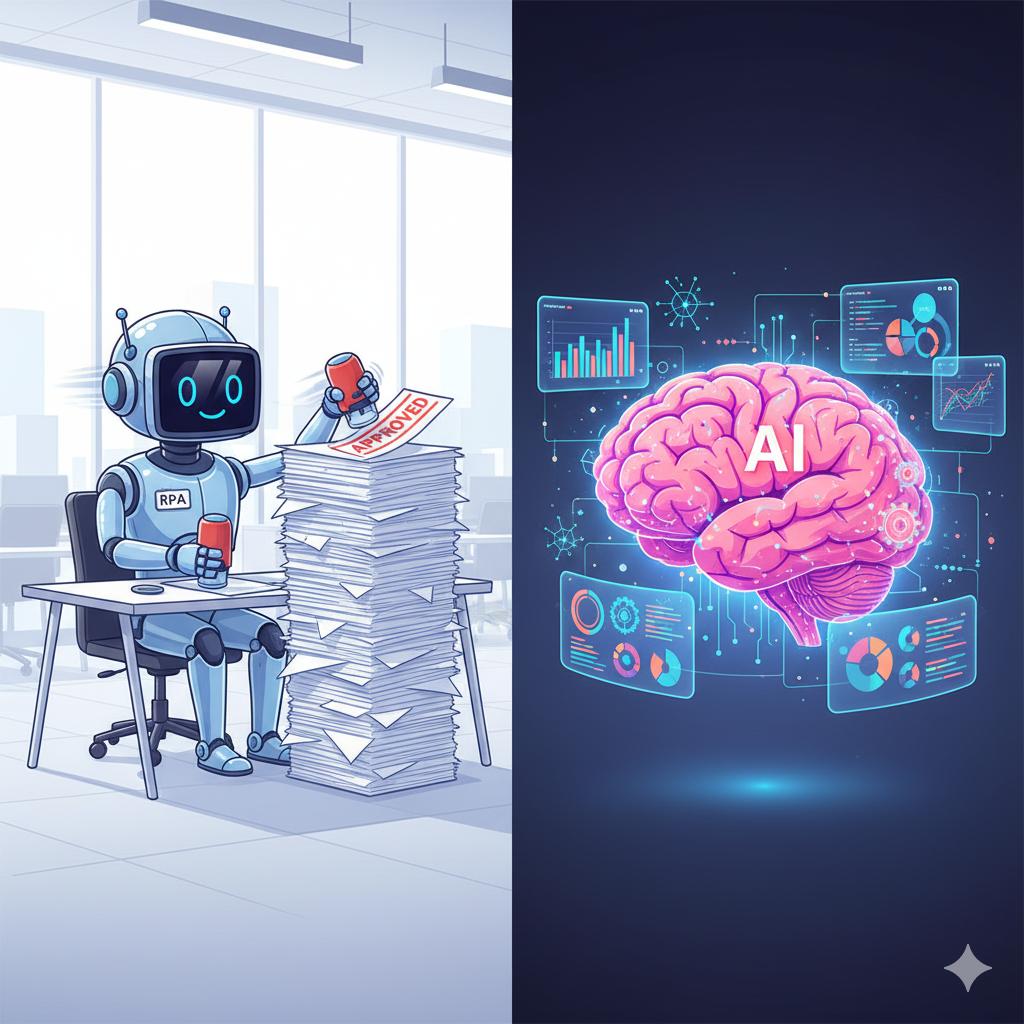
2. The Simple Analogy: The Dedicated Clerk vs. The Adaptive Brain
In order to make this point utterly clear, let's create a simple analogy.
RPA is the Dedicated, Tireless Clerk.
This clerk is fantastically quick, never fatigues, and never blunders—provided you provide them with an exact, step-by-step rulebook. For instance: "Grab the invoice from this folder, locate the invoice number in the top-right corner, input it into cell A1 of this spreadsheet, and copy in the total amount into cell B1." The clerk does this flawlessly, tens of thousands of times a day. But if an invoice is laid out differently or is a scan PDF, the clerk pauses and flags it because it hasn't a clue what to do. It doesn't get the content, just the process.
AI-Powered Automation is the Adaptive, Analytical Brain.
That brain can examine that same pile of bills, whether scanned PDFs and pictures, and know what it's looking at. It can scan the text (Optical Character Recognition), understand that the number at the top-right is the "invoice number," and the number at the bottom is the "total." It can even verify this information with previous history to forecast if an invoice would likely turn out to be fraudulent. If it encounters a new, complex format, it can use its learning to make an educated guess, becoming more accurate over time.
The clerk is perfect for structured, predictable work. The brain is essential for unstructured, variable, and cognitive work.

3. What is RPA? The Digital Workhorse for Repetitive Tasks
Robotic Process Automation (RPA) is a technique that programs software "bots" to mimic and automate the actions a human would take in interacting with computer systems. Its fundamental attributes are:
Rules-Based: It functions based on pre-specified, deterministic if-then rules. (e.g., IF the status field is "Approved," THEN click the "Process" button).
Surface-Level Integration: It operates at the presentation layer of software (the UI), similar to a human user. This implies it does not need deep, costly API integrations into legacy systems.
Structured Inputs: It needs very structured and standardized inputs to operate, like data from specified fields in a CRM, ERP, or standardized Excel file.
Deterministic Output: Given the same input, you will always produce the same output. No ambiguity or probability.
Typical Use Cases for RPA:
Data migration and entry between systems (e.g., from emails into a database).
Automated distribution and generation of reports.
High-volume processing of invoices from a standardized template.
IT support activities such as user account provisioning and de-provisioning.
Repetitive checks on onboarding customers.

4. What is AI-Powered Automation? The Intelligent System for Complex Decisions
AI-Driven Automation utilizes subfields of artificial intelligence—such as Machine Learning (ML), Natural Language Processing (NLP), and Computer Vision—to perform tasks that demand comprehension, forecasting, and adjustment. Its defining features are:
Cognitive and Learning-Based: It applies statistical models to identify patterns in data and enhances its performance with time as it is subjected to increased data.
Handles Unstructured Data: It can deal with and make sense of data from unstructured sources such as emails, documents, images, videos, and audio files.
Probabilistic Outputs: Its conclusions are frequently expressed in terms of confidence scores or probabilities. (e.g., "This customer email has a 98% chance of being a complaint.")
Predictive and Adaptive: It can predict future results (e.g., customer churn prediction) and modify its behavior on the basis of new information.
Common Use Cases for AI-Powered Automation
Intelligent Document Processing (IDP) to derive data from diverse invoices, contracts, or forms.
Sentiment analysis of customer sentiment from support tickets and social media.
Predictive maintenance in manufacturing through analysis of sensor readings.
Detection of fraudulent transactions using anomalous patterns.
Chatbots that can comprehend and answer sophisticated, free-form customer questions using AI.
5. The Perfect Fit for RPA: High-Volume, Rule-Based Processes
Robotic Process Automation is best where consistency, speed, and accuracy are critical but no "thinking" is necessary. Consider it the perfect applicant for the dullest tasks in your organization.
Key traits of an RPA-suited process are:
High-Volume and Repetitive: The activity is undertaken often, often hundreds or thousands each day, week, or month.
Rule-Based and Deterministic: The logic for making a decision is simple and can be written in explicit "if-then" rules without any vagueness.
Structured Digital Inputs: The information needed is digital and structured, originating from standardized spreadsheets, databases, or application form fields.
Mature and Stable: The fundamental process and applications are not updated often. RPA bots are brittle and will shatter if a software interface is modified.
Read/Write Across Disparate Systems: The activity consists of logging into, and transferring data between, multiple different systems that could be without pre-existing integrations (e.g., duplicating data from a CRM to an ERP and subsequently to an Excel report).
Prime RPA Candidate Processes:
Data Reconciliation: Pairs records between two systems (e.g., bank statements and internal ledgers).
Mass System Updates: Updating customer statuses or product details in a database in bulk.
Report Automation: Logging into systems, pulling data out, and formatting it in a standard daily or weekly report.
HR Onboarding/Offboarding: Setting up user accounts, granting system access, and processing paperwork for new hires or departing employees.
If your process issue is something that can be addressed with a detailed, step-by-step instruction manual, RPA is probably your most effective and least expensive solution.
6. Where AI Automation Excels: Unstructured Data and Predictive Tasks
AI-Powered Automation is your first choice technology when the work entails interpretation, judgment, or learning from patterns. It addresses work that is currently handled by your most skilled and experienced employees.
Best features of an AI-automation-suitable process are:
Unstructured or Semi-Structured Inputs: The main source of data is not cleanly presented in database fields. These are emails, documents (PDFs, Word documents), images, videos, and audio files.
Cognitive Tasks Involving Comprehension: The activity is reading comprehension, language comprehension, or visual identification.
Pattern Recognition and Forecasting: It aims to recognize patterns, identify anomalies, or predict future scenarios based on past information.
Managing Exceptions and Variability: It is not highly standardized and needs some adaptation to process exceptional cases.
Continuous Improvement is Required: The task improves with increasing accuracy over time as the system becomes wiser from learning about more data and from user feedback.
Prime AI-Automation Candidate Processes:
Intelligent Document Processing (IDP): Automating the extraction of important information (such as vendor, amount, date) from thousands of invoices, contracts, or forms that each have varying layouts.
Customer Support Triage: Examining the incoming support emails or chat requests to discern intent, sentiment, and urgency, then directing them to the proper department or even proposing solutions.
Supply Chain Predictive Analytics: Predicting product demand to maximize stock levels and avoid stockouts or overstocking.
Insurance Claims Fraud Detection: Examining documents and past data to identify suspicious patterns that signal likely fraud for human investigators to pursue.
When your process issue needs a "gut instinct" or subject-matter experience, you require the intelligence of AI.
7. Better Together: How RPA and AI Combine for Hyperautomation
The strongest automation solutions don't have to pick between RPA and AI; they integrate them. This combined approach is also referred to as Hyperautomation—the combined application of several technologies to automate as much of the business process as possible in a manner that is integrated, scalable, and intelligent.
How they work together:
Remember our example of a loan application. A standalone RPA bot would flunk on a scanned bank statement. A standalone AI may be able to comprehend the statement but won't be able to do anything with it. When combined, they form a smooth end-to-end automation:
RPA logs into the loan portal and downloads the application package.
AI takes the scanned bank statement (a document that is unstructured), applies its cognitive capabilities to read and dig out the applicant's balance and income, and returns this now-structured data to the RPA bot.
RPA puts this structured data into the proper fields of the loan processing system.
AI can also scan the entire application to give a risk score.
RPA then applies this score (e.g., "Low Risk") to run the next rule: "IF risk score is Low, THEN approve and continue to the next stage."
In this process, RPA is the hands and feet, shuffling data between applications and running the process, while AI is the eyes and brain, comprehending intricate inputs and making advanced judgments. The collaboration automates the whole process, not merely the simple, structured bits.

8. Making the Choice: A 5-Question Framework for Your Business
You don't have to be a technical genius to make the choice. Ask the following five strategic questions regarding the process that you want to automate:
What is the nature of the input data?
Structured & Digital (e.g., database fields, Excel columns) -> Lean towards RPA.
Unstructured & Analog (e.g., emails, PDFs, scanned forms) -> Lean towards AI.
How much variability and how many exceptions are there?
Low variability, few exceptions -> A good RPA candidate.
High variability, many exceptions -> Needs AI's adaptive intelligence.
What type of "thinking" is needed?
Simple, rule-based decisions (e.g., "If A, then B") -> RPA can do it.
Complex judgment, pattern recognition, or prediction -> You will need AI.
Is the underlying process and software stable?
Yes, it's mature and doesn't change much -> RPA-safe.
No, it keeps changing -> RPA can be too brittle; think if an AI-based process mining strategy is necessary in the first place.
What do we want to achieve mainly?
To speed up and minimize errors in a recurring task -> RPA's main selling point.
To make sense of things, make better decisions, and manage complexity -> AI's value proposition.
Your responses will produce a distinct profile that leads you towards the appropriate technological starting point.
8. The Future Path: Where Are These Technologies Going?
The paths of RPA and AI are converging, but their fundamental natures will endure.
RPA is getting intelligent. Top RPA platforms are pushing hard to integrate AI capabilities (such as document understanding and process mining) right into their products. RPA's future is not as an isolated tool, but as a vital orchestrator and executor within a larger AI-enabled ecosystem. As the "hands" executing on the intelligence delivered by AI, its role will only grow in importance.
AI is getting more ubiquitous and specialized. We are shifting to specialized, pre-trained models for particular industries such as healthcare, legal, and finance. This "AI-as-a-Service" trend will reduce the entry barrier, enabling businesses to tap into powerful AI capabilities for specific tasks without requiring them to build models from ground up. Emphasis will be on making AI easier to integrate, manage, and trust.
The ultimate future is Hyperautomation, in which corporations will employ an integrated technology fabric of RPA, AI, process mining, and analytics to develop self-optimizing businesses. The line between the "doing" and the "thinking" will get blurred, building systems that not only perform processes but also constantly redesign them for optimal performance.
10. Final Verdict: Complementarity, Not Competition
The question is not, "Do I pick RPA or AI?" The best question is, "How do I use RPA and AI together to fix my business challenges?"
They are not competitors; they are necessary allies on the automation journey.
RPA is your gateway to automation. It gives you rapid, tangible ROI on repetitive, high-volume activities. It lays the groundwork and the business case for additional digital change.
AI is your catalyst to smart automation. It addresses the hard, mentally demanding work that frees up new ranges of effectiveness and strategic perspective.
Begin with RPA to produce quick wins and establish an automation culture. Next, add AI to automate exceptions, comprehend the unstructured, and anticipate the future. By recognizing them as complementing forces within your technology stack, you no longer just automate tasks, but you begin to construct a genuinely intelligent, robust, and competitive organization.

 Indian Online Marketing Team
Aug 10, 2025
 Indian Online Marketing Team
Aug 24, 2023
 Indian Online Marketing Team
Aug 24, 2023
 Indian Online Marketing Team
Aug 24, 2023
 Indian Online Marketing Team
Aug 24, 2023