
The Emergence of AI Copywriting: Can Machines Really Substitute for Human Creativity?
The Emergence of AI Copywriting: Can Machines Really Substitute for Human Creativity?
1. Introduction: Why AI Copywriting Is Currently the Most Popular Debate in Marketing
In recent years, artificial intelligence has transitioned from being a "buzzword" to becoming the engine of how companies work. From predictive analytics to customer care chatbots, AI has found its way into almost every corner of digital marketing. But nowhere is the controversy more intense than in the domain of copywriting — the science and art of penning words that sell, convince, and incite action.
Why? Because copywriting isn't merely a matter of stringing words together; it's a matter of knowing human emotion, motivation, and psychology. And so when AI-driven software like ChatGPT, Jasper, Copy.ai, and others began creating complete ad campaigns, blog content, and product copy in mere seconds, marketers were left wondering:
Can human creativity really be replaced by machines?
Will there still be jobs for copywriters in the future?
Or is this just the next stage where humans and machines work together?
This argument isn't purely theoretical. In 2025, AI copywriting has already found its way into advertising campaigns for international brands, startup landing pages, and even high-performing, personalized emails. It's essential to know the benefits and limitations of AI copywriting for companies and copywriters.
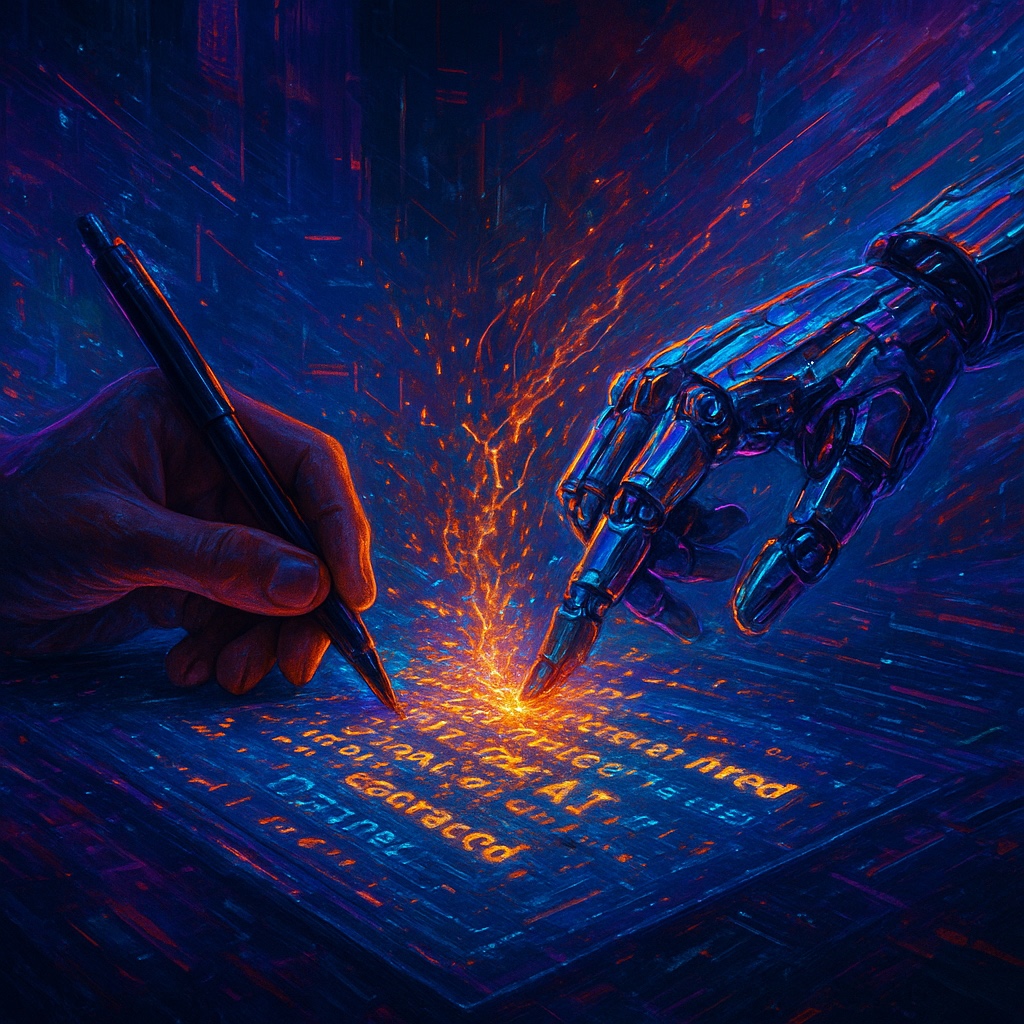
2. What Is AI Copywriting? (And How It Actually Works in 2025)
AI copywriting is the method of using artificial intelligence — generally fueled by machine learning (ML) and natural language processing (NLP) — to produce text for business and marketing use.
This is how it goes in 2025:
In 2025, AI technology doesn't simply spit out words — it parses customer information, past campaign performance, and audience engagement to create laser-targeted copy. That makes it extremely productive. But productivity doesn't always translate to effectiveness — and that's where the human argument starts.
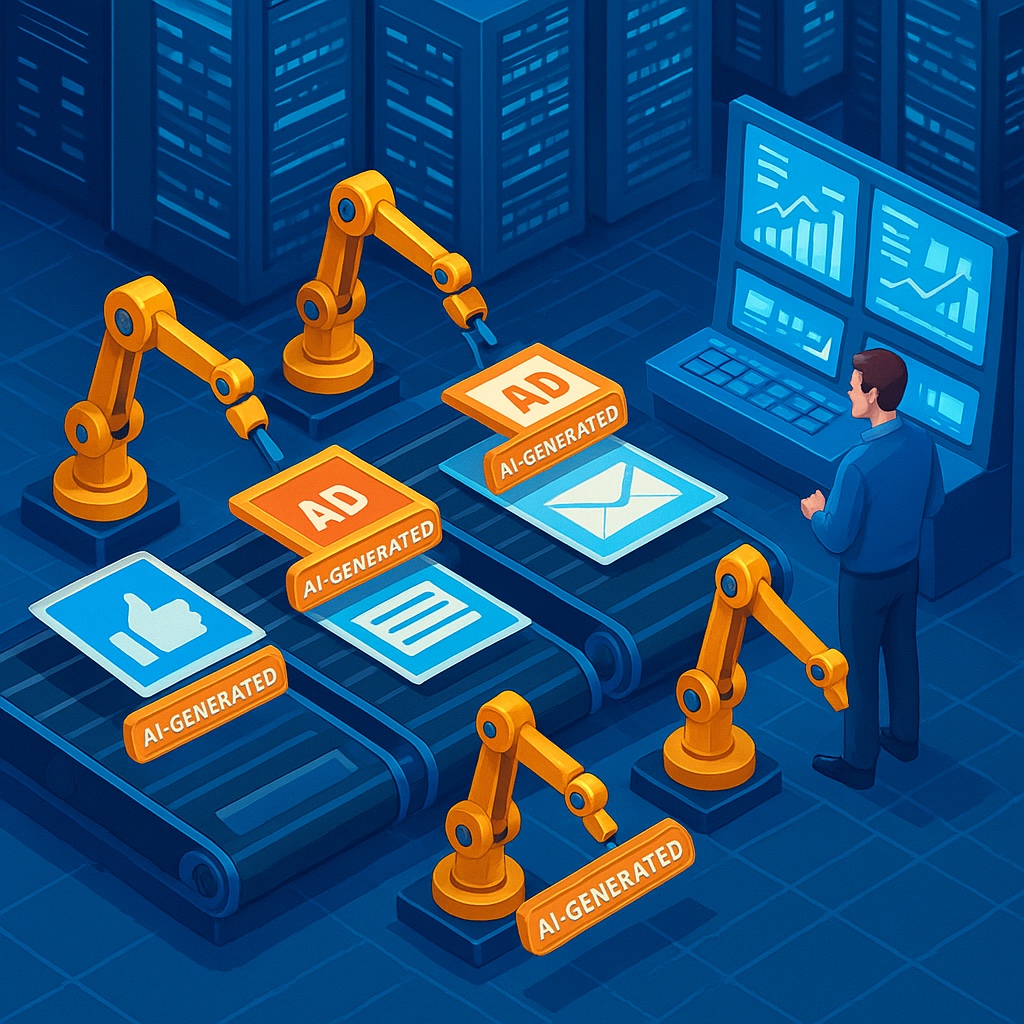
3. The Speed & Scale Advantage: Why Brands Are Turning to AI Tools
One of the most significant reasons why brands are adopting AI copywriting is the sheer speed and scale. What used to take a pool of copywriters days or weeks can be accomplished within minutes today.
For companies executing multi-channel campaigns on Google, Meta, TikTok, and LinkedIn, AI provides a competitive advantage: speed to market and the possibility to test and iterate without burnout.
Yet, while efficiency is provided by AI, the real question remains whether it provides emotional resonance. That's where the next debate starts.
4. The Limitations of AI Copywriting: Where Machines Still Fall Short
Though powerful, AI has definite limitations that all marketers should be aware of in 2025.
Take, for instance, a skincare company looking to run an ad campaign on self-confidence and overcoming insecurity. AI can create polished copy. But it won't ever capture the raw vulnerability of someone's actual experience unless a human molds it.
This restriction makes AI an incredibly powerful tool — but not a complete replacement.
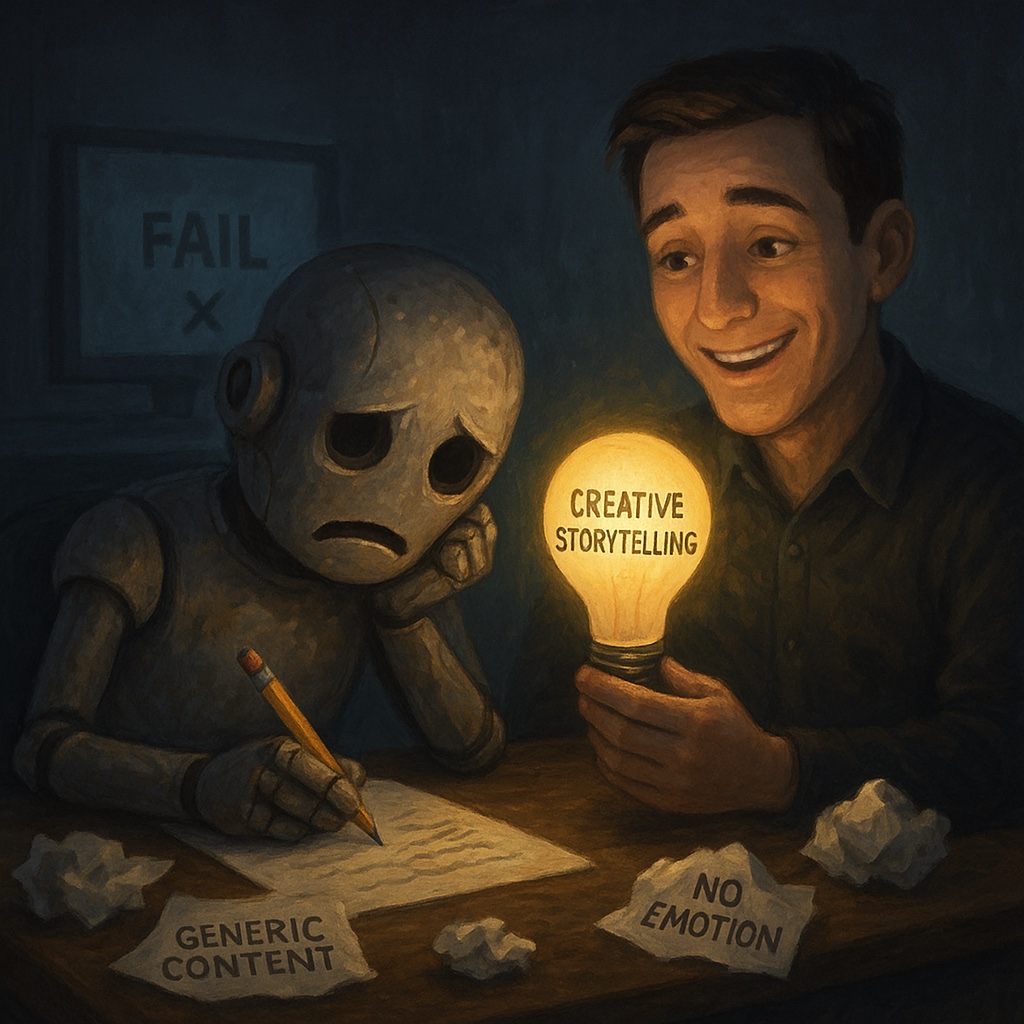
5. The Human Edge: Creativity, Emotion, and Storytelling AI Can't Emulate
At its essence, marketing is storytelling — and more than words, storytelling takes soul.
Humans provide three essential things AI cannot:
In 2025, the best-performing copy is frequently AI + Human collaboration — with AI doing the heavy lifting (speed, variations, testing), and humans bringing the emotional spark that renders the message indelible.
6. Can AI Learn Brand Voice and Cultural Context?
This is perhaps one of the most interesting areas of AI in 2025. AI platforms are far more sophisticated in brand training than they were a couple of years ago. It's possible for a brand to now input AI with hundreds of previous campaigns, customer reviews, and content articles in order to "teach" it their style.
But there's one catch: AI still doesn't get nuances. For instance:
Only humans are capable of picking up on these nuances. Brands that depend 100% on AI risk coming across as tone-deaf or fake — a precarious situation in the world today where one slip can be met with huge backlash.
7. Case Studies: Brands That Successfully Use AI for Copywriting
Theory is fine, but businesses want proof. And in 2025, there are already plenty of real-world case studies showing how AI copywriting is reshaping marketing.
Example 1: E-commerce Product Descriptions
A major Indian e-commerce platform tested AI-generated product descriptions versus human-written ones. The results were fascinating:
Lesson : Speed is wonderful, but emotional connection needs human intervention.
Example 2: SaaS Email Campaigns
A US SaaS company applied AI tools to create subject lines for cold outreach.
Moral of the story : AI can capture attention, but relevance is what triggers action.
Example 3: Global Advertising Campaign
A global FMCG brand employed AI to generate localized ad copy for 20+ markets. The tool implemented cultural adaptation — yet in some markets, AI-mistranslated a word to be offensive. Only when reviewed by humans was the mistake identified.
Lesson : AI may scale, but human review is absolutely indispensable in brand-sensitive sectors.
What these examples demonstrate is that AI isn't replacing people, but augmenting them. Brands that recognize that AI is a partner, not a replacement, are winning.
8. The Dangers of Over-Reliance on AI: Homogenization of Content
Here's an issue nobody discusses enough: when too many brands use AI without creativity, marketing content begins to feel and look the same.
Consider this:
Result?
That homogenization creates a sea of sameness, where brands have no distinct voice. And in an age where attention spans are narrowing, fitting in is the same as being invisible.
The danger of over-reliance is very much real:
AI is a force to be reckoned with, but without human imagination, the world of marketing becomes dull.
9. The Future of Copywriting Jobs: Replacement or Evolution?
This is the million-dollar question. And truthfully, the answer is complex.
Will AI replace all copywriters?
No. The brands that really value storytelling, emotional richness, and authenticity will always require human writers. AI can create drafts, but the final tone has to be human.
What AI will replace
What will survive & thrive
Copywriters possessing strategic thinking, creativity, and in-depth brand knowledge will be in demand. Their functions will shift to:
That is, copywriting careers aren't on their deathbeds — they're evolving. The champs will be those who figure out how to collaborate with AI rather than fight it.
10. The Balance: Human + AI Collaboration for Best Results
The reality is, the greatest marketing in 2025 is a product of a hybrid approach.
Consider AI as the engine, and humans as the driver. The engine provides speed, but only a good driver can navigate the car to the correct destination.
A few real-life applications of this balance:
This equilibrium is what differentiates lazy marketing (AI-alone) and strong marketing (AI + Human synergy).
11. Ethical Issues: Authenticity, Plagiarism, and Trust
AI copywriting isn't merely a technical concern — it's an ethical controversy.
Brands that use AI responsibly — by marrying it with human involvement and being open about using it — will be better off.
12. Last Thoughts: Can Machines Replace Human Creativity?
The short answer: No.
AI can write. AI can optimize. AI can even do brand voices.
But AI cannot dream, it cannot live human moments, and it cannot make stories that make hearts feel the way humans can.
At the same time, labeling AI as "soulless" is no less naive. Companies that do not take AI seriously will be outcompeted by those who apply it to grow, test, and innovate at a faster rate.
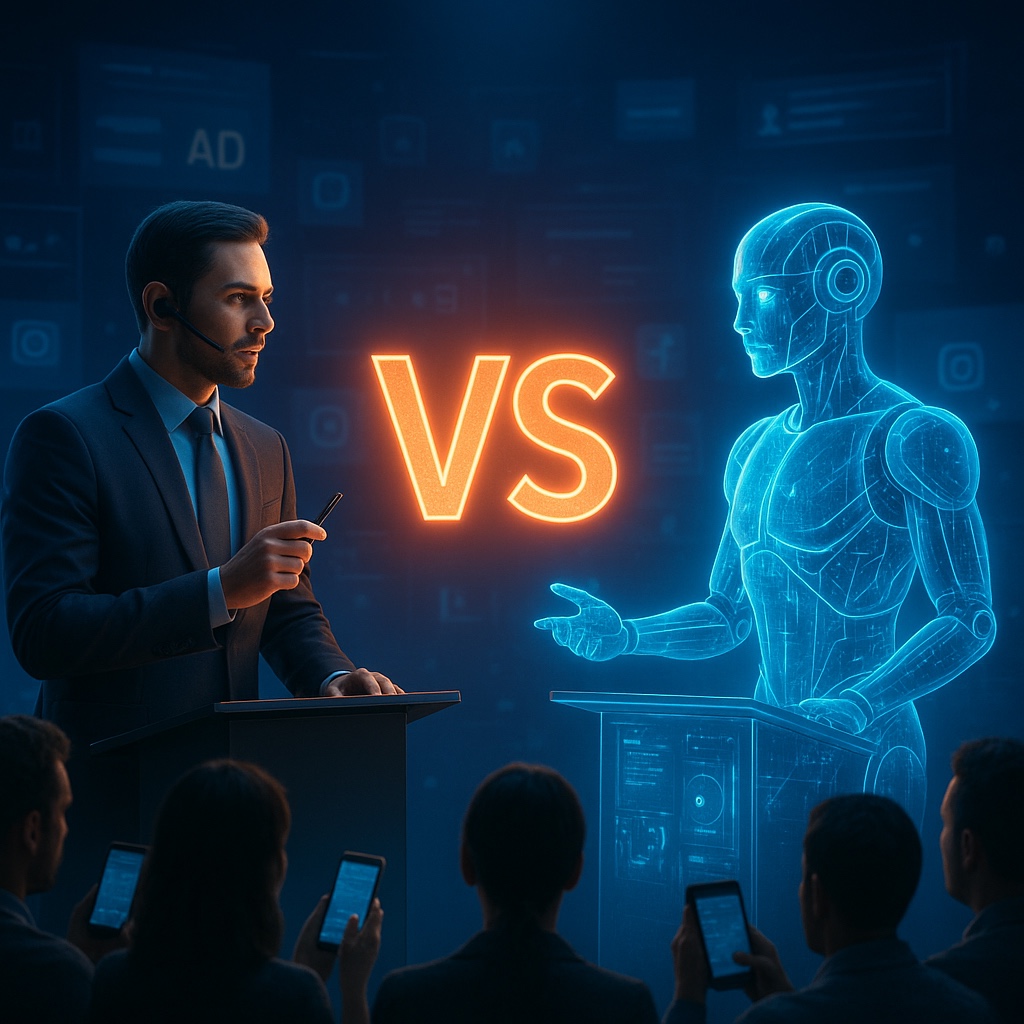
So the actual answer isn't AI vs. Humans. It's AI + Humans vs. Mediocrity.
The future of copywriting is not about replacement, but collaboration. The smartest brands and copywriters will harness AI’s speed while protecting the human spark of creativity.
Because at the end of the day, machines can write words, but only humans can write stories.

 Indian Online Marketing Team
Aug 10, 2025
 Indian Online Marketing Team
Aug 24, 2023
 Indian Online Marketing Team
Aug 24, 2023
 Indian Online Marketing Team
Aug 24, 2023
 Indian Online Marketing Team
Aug 24, 2023