
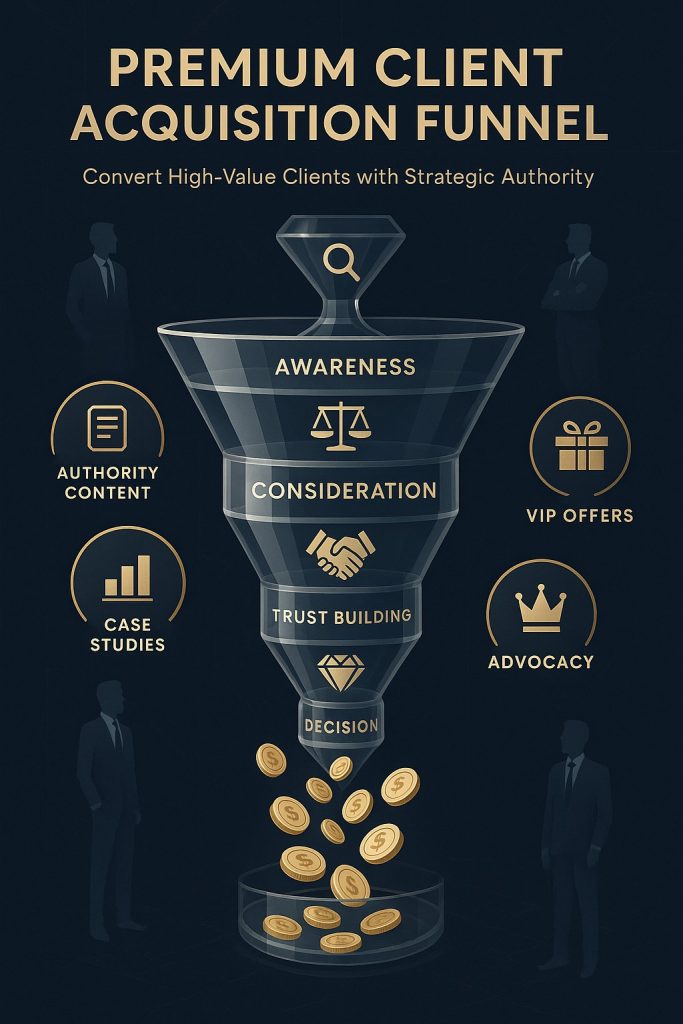
The Definitive Blueprint to Creating a High-Converting Marketing Funnel for Premium
Clients (Step-by-Step)
Winning and converting high-value customers necessitates a radically different strategy than
conventional lead generation tactics – these sophisticated buyers expect superior value,
unshakeable credibility, and customized experiences at each touchpoint. In contrast to
transactional sales funnels optimized for mass-market offerings, a high-end client acquisition
system needs to integrate strategic positioning with careful nurturing to lead sophisticated
buyers through their protracted decision-making process.
Within this comprehensive, 5,000+ word master guide, we'll break down each aspect of a top-
performing client acquisition funnel – from creating irresistible authority-establishing content to
using advanced lead qualifying systems that eliminate time-wasters while pointing out your most
profitable opportunities. You'll learn advanced psychological triggers, tested conversion models,
and behind-the-scenes automation techniques practiced by top agencies and consultants to
bank consistent five and six-figure clients.
1. Introduction: The Critical Differences Between Standard and High-Value Client Funnels
Traditional marketing funnels usually fail spectacularly when applied to high-end services
because they are based on obsolete assumptions regarding buyer psychology – high-net-worth
customers and corporate decision-makers evaluate purchases through an entirely different lens
than average consumers. While mass-market funnels depend on urgency and price sensitivity,
the acquisition of elite clients involves building an air of exclusivity, establishing quantifiable
ROI, and establishing peer-level credibility before even a single sales conversation takes place.
The strongest differentiators in high-end client acquisition are:
● Long Consideration Periods (3-12 months is typical for six-figure+ engagements)
● Multi-Stakeholder Decision Making (Frequently involving CEOs, boards, or executive
committees)
● Severe Risk Aversion (Demanding extensive social proof and case studies)
● Value-Based Pricing Sensitivity (As opposed to cost-based objections)
● Relationship-Centric Buying Criteria (Personal chemistry often trumps features)
Understanding these core distinctions is important because trying to push high-value prospects
through a typical "webinar + discount" funnel will instantly discredit your positioning and
generate the wrong kind of clients. What we'll do instead is create a refined relationship
architecture tuned specifically for premium buyers.
2. Step 1: Clearly Defining Your High-Value Client Profile (Well Beyond Basic
Demographics)
Most companies commit the fatal error of defining "high-value" strictly in terms of revenue
potential, which results in working with nightmarish customers who bring in revenue but drain
profitability with incessant revisions, scope creep, and emotional exhaustion. A highly valuable
customer passes three stringent tests:
The Premium Client Triad Framework
1. Economic Fit
● At least 12-month engagement potential
● Minimum 30% profit margins after delivery expense
● Present path to upsell and expansion revenue
● Payment terms that maximize cash flow
2. Strategic Fit
● Stays true to your core strengths and differentiators
● Works in your "zone of genius" service category
● Offers portfolio-building case study opportunity
● Is your dream industry vertical
3. Relational Fit
● Respects boundaries and protocols of the professional
● Places value on skill over price negotiation
● Exhibits joint decision-making
● Has realistic expectations
Implementation Exercise: Conduct a "Client Autopsy" on your top 3 and bottom 3 previous
clients. Determine the particular behavioral, economic, and psychological indicators that foretold
successful versus catastrophic interactions. Utilize these findings to develop a weighted scoring
system for potential clients.
3. Step 2: The Neuroscience of High-Stakes Decision Making – Mapping the Premium
Buyer's Journey
High-ticket purchases engage distinct neural pathways than habitual purchasing choices,
inducing what psychologists refer to as "high-stakes decision paralysis." Your funnel needs to
compensate for these psychological facts at every point:
The 5-Phase Premium Decision Cycle
1. Latent Need Identification (Months 1-3)
● Prospects have low-grade dissatisfaction but haven't defined solutions
● Content Strategy: Inciting research reports indicating covert costs of inaction
2. Active Exploration (Months 3-6)
● Exploring options without engaging in sales discussions
● Content Strategy: Comparison guides examining solution tradeoffs
3. Shortlisting of Vendors (Months 6-9)
● Narrowing down to 2-3 serious bidders
● Content Strategy: Comparative case studies with measurable outcomes
4. Due Diligence (Months 9-12)
● Rigorous vetting of capabilities and cultural fit
● Content Strategy: Executive briefing reports with implementation roadmaps
5. Commitment (Month 12+)
● Final contract negotiations and contracting
● Content Strategy: Risk-reversal frameworks and success guarantees
Key Insight: It takes an average of 17 separate touchpoints to close an enterprise SaaS sale.
Your content ecosystem has to engage in steady, value-driven contact throughout this long
sales cycle without turning to pushy sales behavior that activates status defense mechanisms in
senior buyers.
4. Step 3: Authority Architecture – Building Unshakeable Credibility in the Awareness
Stage
The basis of high-end client acquisition is building an impenetrable position of authority prior to
any sales discussion taking place – this involves launching a multi-channel thought leadership
campaign that systematically dispels doubt while raising your professional profile. In contrast to
simple content marketing aimed at lead generation, authority architecture integrates intellectual
property creation with strategic visibility platforms to build an unavoidable impression of market
leadership.
The Authority Stack Framework
1. Ground-Level IP Creation
● Develop proprietary models with trademarked terminology (e.g., "The 5-Phase Premium
Decision Cycle" above)
● Publish original studies with statistically relevant data sets
● Create diagnostic tools that expose unrecognized issues
2. Strategic Content Sharing
● Guest posts in industry journals read by C-suite executives
● Research collaborations with academias
● Cited contributions to regulatory white papers
3. Social Proof Construction
● Third-party video recommendations with particular results claims
● Peer-reviewed case studies with audited metrics
● Executive advisory board endorsements
Implementation Example: A management consultant could develop:
● An annual "State of Digital Transformation" report quoted by mainstream media
● A proprietary "Enterprise Readiness Assessment" tool employed by Fortune 500
companies
● A podcast with honest interviews with incumbent CEOs
5. Step 4: The Trust Acceleration Matrix – Middle-Funnel Conversion Engineering
With awareness established, your funnel must now compress months of natural relationship
development into a structured trust-building sequence that overcomes the extreme risk aversion
of premium buyers. This requires deploying psychological triggers through specific content
formats at precisely timed intervals.
The 4×4 Trust Matrix
1. Competence Proof
● Live diagnostic sessions with instant insights
● Annotated work samples showing decision processes
● "Before Admission" client screening questionnaires
2. Integrity Proof
● Transparent pricing frameworks with rationale
● Unscripted team member interviews
● Client termination case studies (why relationships ended)
3. Likability Proof
● Behind-the-scenes culture documentaries
● Personal philosophy manifestos
● Vulnerability-based storytelling
4. Social Consensus Proof
● Anonymous peer benchmarking data
● Blind client reference programs
● Executive dinner event footage
Critical Timing: Each proof element needs to be shared at critical emotional inflection points in
the buyer's process – for example, competence proof becomes less persuasive once due
diligence begins, when integrity proof takes center stage.
6. Step 5: The Premium Offer Stack – Designing Irresistible High-Ticket Propositions
Value-based service packaging breaks with premium customers because it is deliverable-centric
instead of being transformational. Your offer structure has to speak value across multiple
psychological axes while removing all possible objections before they appear.
The 5-Layer Offer Stack
1. Intellectual Foundation
● Proprietary methodology documentation
● Certification in your operating framework
● Implementation playbooks
2. Transformation Blueprint
● Phased results roadmap with milestones
● Success probability assessment
● Risk mitigation protocols
3. Execution System
● Dedicated resource team matrix
● Technology stack requirements
● Integration playbooks
4. Assurance Framework
● Performance-based compensation elements
● Early termination clauses
● Succession planning
5. Elite Access
● Private advisory forums
● Executive retreat invitations
● Market intelligence briefings
Example: A $250K/year consulting engagement may include:
● The "Enterprise Growth Decoder" methodology playbook
● Quarterly "Growth Council" sessions with other clients
● A "Performance Bond" where fees adjust based on KPIs
● Bi-annual private strategy retreats
7. Step 6: Automated Intimacy – Scaling Personalization Through Technology
The fatal mistake most companies make is equating automation with impersonal communication
– high-end customers expect advanced personalization at scale, which involves deploying an
"automated intimacy" system that blends behavioral tracking with AI-driven personalization.
The Automated Intimacy Stack
1. Behavioral Tracking Layer
● Content engagement scoring
● Meeting sentiment analysis
● Email response patterns
2. AI Enhancement Layer
● Dynamic content personalization
● Predictive next-step recommendations
● Tone-matching communication
3. Human Touch Layer
● Strategic handwritten notes
● Surprise value deliveries
● Anniversary recognition
Implementation Example: When a prospect:
● Downloads 3+ methodology documents → Triggers a VIP briefing invitation
● Watches 75% of a case study video → Sends a personalized results analysis
● Misses a scheduled call → Initiates a concierge-level rescheduling
8. Step 7: The Prestige Filter – Advanced Lead Qualification Frameworks
Traditional qualification techniques don't work for high-end services because they evaluate
surface-level traits instead of the psychological and strategic fit needed for successful
interactions.
The 4-Dimensional Prestige Filter
1. Strategic Fit Assessment
● Decision-making process mapping
● Organizational change readiness
● Cultural alignment indicators
2. Economic Fit Verification
● Budget source analysis
● ROI expectation calibration
● Payment capacity proof
3. Relational Fit Evaluation
● Communication style matching
● Conflict resolution tendencies
● Power dynamic assessment
4. Transformational Fit Diagnosis
● Change commitment level
● Execution capability
● Patience for results
Tool Example: A "Client Compatibility Index" that scores prospects across 12 weighted
dimensions before permitting sales conversations, automatically disqualifying mismatched
opportunities while fast-tracking ideal candidates.
9. Step 8: The Client Ascension Pathway – Post-Sale Value Amplification
The real profit in premium services is in client lifetime value optimization through intentional
ascension paths that intensify engagement while generating natural referral opportunities.
The Ascension Matrix
1. Onboarding Ceremonies
● Welcome ritual experiences
● Success artifact creation
● Stakeholder alignment sessions
2. Value Reinforcement
● Quarterly business reviews
● Surprise value deliveries
● Executive briefings
3. Community Building
● Private peer forums
● Mastermind experiences
● Advisory councils
4. Legacy Creation
● Joint intellectual property
● Published case studies
● Referral incentive programs
Example: A law firm may develop:
● "General Counsel Circle" membership for high-value clients
● Yearly "Legal Innovation Summit" invitation
● Co-authored industry white papers
● "Prestige referred by" branding in communications
10. Conclusion: The Premium Funnel Mindset Shift
Shifting from commodity to premium client acquisition involves radically rethinking every
element of your marketing psychology, sales process, and service delivery. The most important
mindset shifts are:
● From Lead Volume to Lead Quality (Measuring fit over quantity)
● From Sales Conversations to Strategic Dialogues (Positioning as peer rather than
vendor)
● From Service Delivery to Transformation Architecture (Selling outcomes not hours)
● From Client Satisfaction to Client Advocacy (Engineering delight at every touchpoint)
Final Implementation Checklist:
1. Conduct a full premium client audit using the Triad Framework
2. Map your existing content to the 5-Phase Decision Cycle
3. Create at least one proprietary authority-building asset
4. Redesign your lead qualification process with the Prestige Filter
5. Build your first Automated Intimacy workflow
6. Plan your first Client Ascension experience
By methodically putting this overarching system to work, you'll turn your client acquisition
process into a strategic asset that will always attract and retain the best clients in your market.
abSalam
Lorem ipsum dolor sit amet consectetur adipiscing elit, vestibulum lectus egestas cubilia nam sagittis, nulla posuere habitant